 |
Universiteit van Amsterdam
Faculteit der Maatschappij- en Gedragswetenschappen
Afdeling Sociologie en Antropologie
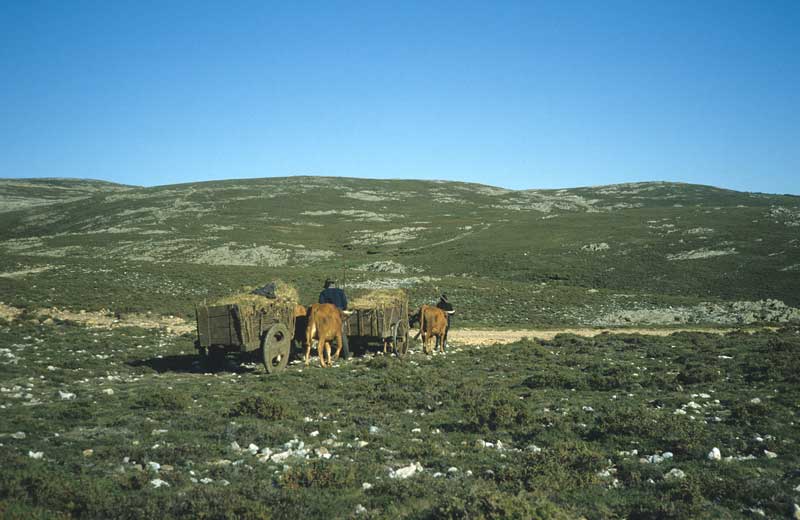
OS BALDIOS
Een onderzoek naar de levensvatbaarheid
van een socialistische wet met betrekking tot
de communale dorpsgronden in Portugal
Doctoraalscriptie van
Roel Klein
en
Bert Stok
Begeleider: Dr. N.O Kielstra
Amsterdam, juni 1986
Summary
|
Samenvatting
|
Gehele tekst
| Literatuur
| Contact
Summary
The last of the land reform laws introduced in 1975/76 and
originating out of the "Carnation Revolution" of 1974 was
the baldios-law. The aim of this law, which fell under the
Agrarian Reform, was to give back to the local population
the communal lands (baldios), which had been confiscated by
the state under the Salazar regime in order to realize a
large-scale afforestation project. Along with land
restitution, this law provided for local governing councils
which were to carry out the communal management of the
baldios.
In view of the considerable problems which surround the
realization of this law, we asked ourselves to what extent
the baldios-law could be considered to be viable. This
question had to be placed in the general context of the
problems and dilemmas surrounding "left-wing" agrarian
policies. First however we had to explain how the baldios
could still be a political issue at the time of the
revolution in 1974. The following four issues proved to be
of importance:
- the factors which led to the continued existence of the
communal lands in a number of places,
particularly in
northern Portugal, up until the Salazar period;
- the nature of state intervention, particularly around the
large-scale afforestation project, under the
Salazar regime;
- the nature of the changes which took place during the past
few decades in those village
communities which still had
communal lands at their disposal;
- the political developments directly following the
revolution of 1974.
Whether or not the baldios-law would prove viable depends in
our opinion on the following factors:
- the outcome of the political controversies surrounding
this issue on the national level;
- the problems surrounding the realization of this
legislation on the local level;
- the extent to which this law can meet its own ends.
The original ideas and motives behind the baldios-law were
socio-economic, managerial and politico-ideological in
nature. The socio-economic aim was to raise the standard of
living in those communities to which the law applied. The
managerial aim was to increase the sense of responsibility
of the local population for the forest reserve. The
politico-ideological aim was to introduce new forms of
collective management of production units which would
provide "training" in socialism and collectivism. By
reverting to a communal institution like the baldios, the
Portuguese left hoped to counter the growing trend towards
individualism and to give collectivism a new lease of life.
On the national level, the controversies centered around the
politico-ideological, financial and economic aspects of this
legislation. We have tried to argue that, aside from the
outcome of these controversies, which will in itself
determine the political fate of the baldios-law, the origins
of the problems surrounding the concrete realization of this
legislation can be traced back to the inadequate analyses
made by the political left concerning the nature of the
village communities which had communal lands at their
disposal up until the Salazar period, and regarding the
changes which had taken place in those same communities over
the past decades. A critique of this analyses is partly
based on the results of our own research. We seriously
question whether the baldios possess that social content
which is normally attributed to them. We doubt that this
institution can provide a base for collectivism, or that it
can provide the foundation for a socialist model of
agricultural production. We also maintain that the
assumption that one can make small farmers or peasants
receptive to socialist ideas by deploying strategic methods
behind their backs has only added to the problems.
To see the entire (Dutch) text, click
here
Samenvatting
Als laatste in de reeks landhervormingswetten uit de
periode 1975/76 voortvloeiende uit de Portugese
Anjerrevolutie van 1974, werd de wet op de baldios
uitgevaardigd. Deze wet, die onderdeel vormt van de
Agrarische Hervorming, behelst de teruggave aan de lokale
bevolking van de communale dorpsgronden, welke onder het Salazar-regime door de staat in beslag waren genomen ter
realisatie van een grootschalig bebossingsproject. De
teruggave van de communale gronden werd in de wet gekoppeld
aan het in het leven roepen van lokale bestuursraden, die op
gemeenschappelijke wijze de gronden dienden te gaan beheren.
Aangezien de uitvoering van de wet op een aantal grote
problemen stuit, hebben wij ons de vraag gesteld in hoeverre
de wet op de baldios levensvatbaar moet worden geacht. Dit
moet dan worden bezien tegen de achtergrond van de meer
algemene vraag wat de problemen en dilemma's zijn van een
"linkse" agrarische politiek met betrekking tot kleine
boeren. Allereerst moest echter de vraag beantwoord worden,
hoe het mogelijk was dat de baldios ten tijde van de
revolutie van 1974 nog een politieke kwestie konden vormen.
Hierbij zijn vooral de volgende vier elementen van belang:
- de oorzaken van het feit dat tot aan de vestiging van het Salazar-regime op vele plaatsen, met
name in
Noord-Portugal, communale gronden zijn blijven bestaan;
- de aard van de staatsinterventie, met name het
grootschalig bebossingsproject, onder het
corporatisme;
- de aard van de veranderingsprocessen die zich de afgelopen
decennia hebben voltrokken in die
dorpsgemeenschappen die
nog beschikken over stukken communale grond;
- de politieke ontwikkelingen direct volgend op de revolutie
van 1974.
De levensvatbaarheid van de wet op de baldios is onzes
inziens afhankelijk van de volgende factoren:
- de uitkomst van de controversen met betrekking tot de wet
op het nationale niveau;
- de problemen met de uitvoering van de wet op het lokale
niveau;
- de vraag in hoeverre de wet aan haar eigen doelstellingen
kan voldoen.
De achterliggende ideeën en motieven van de wet zijn van sociaal-economische, beheerstechnische en
politiek-ideologische aard. Sociaal-economisch in de zin van
het verhogen van het levenspeil in die gemeenschappen waar
de wet betrekking op heeft; beheerstechnisch in de zin van
het vergroten van het verantwoordelijkheidsgevoel bij de
plaatselijke bevolking ten aanzien van de bossen;
politiek-ideologisch in de zin van het in het leven roepen
van vormen van collectief beheer van productie-eenheden, die
dan als "leerschool" moeten dienen voor socialisme en
collectivisme. Links poogde door terug te grijpen op een
communaal instituut als de baldios de recente
individualiseringstendensen te kunnen keren en het
collectivisme nieuw leven in te blazen.
De controversen met betrekking tot de wet spelen zich
voornamelijk af op het politiek-ideologische, financiële en
economische terrein. We hebben trachten aan te tonen dat
afgezien van de uitkomst van deze controversen, welke de
algemene politieke voorwaarde vormt voor de effectuering van
de betreffende wet, de problemen met de uitvoering vooral
zijn terug te voeren op de gebrekkige en inadequate analyses
die door "links" zijn gemaakt ten aanzien van zowel het
karakter van de dorpsgemeenschappen, die tot aan de
vestiging van het Salazar-bewind nog de beschikking hadden
over communale grond, als van de veranderingsprocessen die
hier de afgelopen decennia hebben plaatsgevonden. We hebben
mede op basis van eigen onderzoek deze analyses bekritiseerd
en willen dan ook betogen dat het ten zeerste de vraag is of
het verschijnsel "baldio" wel die sociale inhoud heeft die
haar in het algemeen wordt toegeschreven. Het valt te
betwijfelen of op basis van dit instituut het collectivisme
kan worden gestimuleerd en een basis kan worden geschapen
voor een socialistisch georganiseerde landbouw. Daarnaast
komen ons inziens de dilemma's mede voort uit de visie als
zou men via strategische middelen, achter de ruggen van de
betrokkenen om, de kleine boer ontvankelijk kunnen maken
voor socialistische ideeën.
Voor de gehele tekst klik
hier
LITERATUUR
Almeida, J. Ferreira de (1980), "Quem faz o arraial é o pavo":
mudança social e mudança cultural.
In: Análise Social,
2e serie, Vol.XVI, nr.64; Lisboa
Anderson, P. (1978), Passages from Antiquity to Feudalism;
NLB, London
Baptista, F. O. (1978), Portugal 1975 - Os Campos;
Afrontamento, Porto
Bennema, J. W. (1978), Traditions of Communal
Co-operation among Portuguese Peasants;
Universiteit van
Amsterdam, Amsterdam.
Bernstein, H. (1982), Notes on Capital and Peasantry. In:
Harriss, J., Rural Development. Theories
of peasant
economy and agrarian change; Hutchinson University
Library, Hutchinson & Co,
London
Blok, A. (1978), Antropologische Perspectieven;
Coutinho, Muiderberg.
Boissevain, J. (1977), When the saints go marching out:
Reflections on the decline of patronage in
Malta. In:
Patrons and Clients in Mediterranean Societies; Gellner
& Waterbury (ed.); London
Bordalo Lema, P. (1978), Tourém, uma aldeia raiana do
Barroso; Centro de Estudos Geográficos
da Universidade
de Lisboa, Lisboa.
Brongersma, A., Corporatief Portugal. Salazar - een
bloemlezing uit zijn redevoeringen; Brand,
Hilversum
Castro Caldes, E. (1947), Formas de Exploração da
Propriedade Rustica, Lisboa
Chayanov, A. V. (1966), On the Theory of Peasant
Economy; D. Thorner, B. Kerblay,
R.E.F. Smit (ed.);
Richard D. Irwin, Homewood, Ill.
Chevalier, M. (1983), There is Nothing Simple about Simple
Commodity Production. In: The Journal
of Peasant Studies,
Vol. 10, nr. 4; Frank, Cass & Co, Ltd, London.
Clavaud, F. & G. Marchais (1972), Les Communistes et les
Paysans; Editions Sociales, Paris
Costa Mendonça, J. da (1961), 75 Anos de Actividade
na Arborização de Serras; Direcção-Geral
dos Serviços
Florestais e Aquicolas, Lisboa.
Cunhal, A. (1976), Contribuição para o Estudo da Questão
Agrária, Vol II; Edições Avante, Lisboa
Cutileiro, J. (1971), A Portuguese Rural Society;
Clarendon Press, Oxford.
Dias, J. (1949), Minho, Trás-os-Montes, Haut-Douro (congres
international de geografie)
Dias, J. (1953), Rio de Onor, comunitarismo agro-pastoril;
Editorial Presença, Lisboa.
Djurfeldt, G. (1982), Classical Discussions of Capital and
Peasantry: a critique. In Harriss, J.,
Rural Development.
Theories of peasant economy and agrarian change;
Hutchinson
University Library, Hutchinson & Co, London
Engels, F. (1973), De Mark. In: Over het
Boerenvraagstuk; Pegasus, Amsterdam
Ennew, P., P. Hirst & K.Tribe (1977), Peasantry as an
Economic Category. In: The Journal of
Peasant Studies;
Vol. 4, nr. 4, Frank, Cass & Co, Ltd, London.
Erasmus, C. (1965), The Occurrence and Disappearance of
Reciprocal Farm Labour in Latin
America. In: D. Heath & R.
Adams (ed.), Contemporary Cultures and Societies of Latin
America; Random House, New York.
Estêvão, J. (1983), A Florestação dos Baldios. In:
Análise Social; 3e serie, Vol.XIX, nr.77,78,79,
Lisboa.
Ettema, W. (1980), Spanish Galicia: a case study in
peripheral integration; Utrechtse Geografische
Studies
18, Utrecht
Figueredo, A. de (1975), Portugal: Fifty Years of
Dictatorship; Penguin Books Ltd, Harmondsworth
Fontes, A. L. (1977), Etnografia Transmontana II: O
Comunitarismo do Barroso, Montalegre
Foster, G. M. (1967), Peasant Society and the Image of
Limited Goods. In: J. M. Potter, M. Diaz &
G.M. Foster,
Peasant Society: a reader; Little Brown & Company,
Boston
Freitas, E. de e.a. (1976), Modalidades de
Penetração do Capitalismo na Agricultura; Editorial
Presença, Lisboa
Friedmann, H. (1980), Household Production and the
National Economy. Concepts for the analysis
of agrarian
social formations. In: The Journal of Peasant Studies;
Vol. 7, nr. 2, Frank,
Cass &Co, Ltd, London.
Goldey, P. (1983), Migração e Relações de Produção: a terra
e o trabalho numa aldeia do Minho,
1876-1976. In: Análise
Social; 3e serie, Vol. XIX, nr. 77,78,79, Lisboa
Habermas, J. (1981), Theorie des Kommunikativen Handelns,
Band 2, Zur Kritik der
Funktionalistischen Vernunft;
Surkamp Verlag, Frankfurt am Main.
Habermas, J (1981a), Naar een Reconstructie van het
Historisch Materialisme. In: Marxisme en
Filosofie;
Boom, Meppel.
Halpern Pereira, M. (1971), Livre Câmbio e
Desenvolvimento Economico. Portugal na segunda
metade do
século XIX; Edições Cosmos, Lisboa.
Halpern Pereira, M. (1978), As Origens Históricas do
Subdesenvolvimento Português. In: Análise
Social; 2e
serie, Vol. XIV, nr. 53, Lisboa.
Harvey, R. (1978), Portugal: Birth of a Democracy;
The Macmillan Press, Ltd,
London & Basingstoke.
Jenkins, R. (1979), The Road to Alto; Pluto Press,
London.
Lenin, V. I. (1977), The Development of Capitalism in
Russia. In: Lenin: Collected Works, Vol. 3,
Progress
Publishers, Moscow.
Lewis, O. (1951), Life in a Mexican Village: Tepoztlán
restudied; University Illinois Press,
Urbana, Ill.
Li-Causi, L. (1975), Anthropology and Ideology, the Case of
Patronage in Mediterranean Societies.
In: Critique of
Anthropology; nr. 4/5, London
Littlewood, P (1980), Patronage, Ideology and Reproduction.
In: Critique of Anthropology, jrg. 15,
vol. 4,
London.
Long, N. (1984), Creating Space for Change. A perspective on
the sociology of development.
In: Sociologia Rurales;
Vol. XXIV, 3/4.
Louro, V. & L. Martins (1975), Baldios, uma Questão
Política; Uitgave PCP, Lisboa.
Lucena, M. de (1976), 0 Salazarismo, Perspectivas e
Realidades; Lisboa.
Madureira Pinto, J. (1981), Solidaridade de Vizinhança
e Oposições de Classe em Colectividades
Rurais. In:
Análise Social; 2e serie, Vol. XVII, nr. 66, Lisboa.
Mann, S.A. & J.M. Dickinson (1978), Obstacles to the
Development of Capitalist Agriculture. In: The
Journal of Peasant Studies; Vol. 5, nr. 4, Frank, Cass & Co, Ltd,
London
Marinho Antunes, M. L. (1981), Migrações, Mobilidade Social
e Identidade Cultural, factos e hipóteses sobre o caso
Português. In: Análise Social, 2e serie, Vol. XVII,
nr.65, Lisboa.
Martinho, A. (1981), O Pastoreio e o Queijo da Serra;
Colecção Parques Naturais, Lisboa
Marx, K. (1967), Capital, Vol. II; Progress
Publishers, Moscow
Marx, K. (1976), De 18e Brumaire van Louis Bonaparte;
Pegasus, Amsterdam.
Marx, K. (1977), Capital, Vol. III; Progress
Publishers, Moscow
Marx, K. (1978), Het Kapitaal; Unieboek, Bussum
Moreira Alves, M. (1976), De Portugese Soldaten en het
Socialisme; In de Toren, Baarn
Mota, R. (1980), Cambezes do Rio, uma aldeia comunitaria
em Trás-os-Montes; leeronderzoek,
Antropologisch
Sociologisch Centrum, Universiteit van Amsterdam, Amsterdam
Mouzelis, N. (1979), Peasant Agriculture, Productivity
and the Laws of Capitalist Development:
a reply to
Vergopoulos. In: The Journal of Peasant Studies,
Vol.6, nr.3. ,London
Offenberg, A. & P. de Wit (1981), Kleine Boeren en de
Portugese Agrarische Hervorming, Tulipa
Vermelha,
Amsterdam
Oliveira Marques, A. H. de (1982), História de Portugal,
Vol. I; Palas Editores, Lisboa
Oliveira Marques, A. H. de (1983), História de Portugal,
Vol. II; Palas Editores, Lisboa
Oliveira Marques, A. H. de (1981), História de Portugal,
Vol.III; Palas Editores, Lisboa
O'Neill, B. J. (1980), Proprietários, Jornaleiros e
Criados numa Aldeia Transmontana desde 1886;
vert. R.G.
Feijó, Lisboa
O'Neill, B. J. (1982), Trabalho Cooperativo numa Aldeia do
Norte de Portugal. In: Análise Social;
3e serie, Vol.
XVIII, nr. 70, Lisboa.
Pais, J. M. e.a. (1976), Elementos para a História do
Fascismo Português nos Campos. In: Análise
Social,
nr. 46, Lisboa.
Paula Coelho, A. R. (1974), A Campanha do Trigo e a Junta de
Colonização Interna. In: Villaverde
Cabral, Materiais
para a História da Questão Agrária em Portugal - Sec. XIX e
XX; Editoral
lnova, Porto.
Peixoto, R. (1974), Formas de Vida Comunalista. In:
Villaverde Cabral, Materiais para a História da
Questão
Agrária em Portugal - Sec XIX e XX; Editorial Inova,
Porto.
Pereira, V. (1959), Cancioneiro de Arouca, Junta de
Provincia do Douro-Litoral, Porto.
Pereira da Silva, A. (1973), Ocupação sem Limites;
Prelo Editora, S.A.R.L., Lisboa
Perelman, M. (1979), Obstacles to the Development of a
Capitalist Agriculture, a comment on
Mann & Dickinson. In:
The Journal of Peasant Studies; Vol. 7, nr. 1, Frank,
Cass & Co, Ltd,
London.
Polanah, L. (1981), Comunidades Camponesas no Parque
Nacional de Peneda-Gerês; Serviço
Nacional de Parques,
Reservas e Património Paisagístico, Lisboa
Poulantzas, N. (1976), The Crisis of the Dictatorships:
Portugal, Spain, Greece; NLB, London.
Rentes de Carvalho, J. (1975), Portugal, de Bloem en de
Sikkel; Arbeiderspers, Amsterdam.
Ribeiro, A. (1979), Quando os Lobos Uivam; Bertrand,
Lisboa.
Ribeiro, O. (1949), Le Portugal Central; Congrés
International de Geografie, Lisboa.
Riegelhaupt, J. Firstenberg (1973), Religious Action in
Portugal, Festas and Padres: The
organisation of religious
action in a Portuguese parish. In: American
Anthropologist,
Vol. 75, 1973 I, American
Anthropological Association, Washington D.C.
Riegelhaupt, J. Firstenberg (1979), Camponeses e Política no
Portugal de Salazar. In: Análise
Social; 2e serie,
Vol. XV, nr. 59, Lisboa.
Rocha, E. (1979), Evolução do Defice Externo Agrícola,
particularmente no domínio alimentar,e
suas causas. In:
Análise Social; 2e serie, Vol. XV, nr. 60, Lisboa
Sahlins, M. (1972), Stone Age Economics;
Aldine-Atherton Inc., Chicago.
Salazar, A. Oliveira de (1974), A Questão do Trigo. In:
Villaverde Cabral, Materiais para a História da
Questão
Agrária em Portugal - Sec. XIX e XX; Editoral lnova,
Porto.
Serrão, J. (1982), A Emigração Portuguesa; Livros
Horizonte, Lisboa
Shanin, T. (1971), Peasants and Peasant Society;
Penguin Books, Harmondsworth
Shanin, T. (1973), The nature and Logic of the Peasant
Economy, I: a Generalisation. In: The
Journal of Peasant
Studies; Vol. 1, nr. 1, Frank, Cass & Co, Ltd, London.
Silbert, A. (1966), Le Portugal Mediterranéen – a la fin
de l’Ancien Regime, XVIIIème, début du
XIXème siècle;
SEVPEN, Paris.
Silbert, A. (1981), Do Portugal do Antigo Regime ao
Portugal Oitocentista; Livros Horizonte, Lisboa.
Silva, C. en M. van Toor (1982), Verzet van Kleine Boeren
in Noord-Portugal; doctoraalscriptie,
Universiteit van
Amsterdam, Amsterdam.
Silverman, S. (1979), The Peasant Concept in Anthropology.
In: The Journal of Peasant Studies;
Vol. 7, nr. 1,
Frank, Cass & Co Ltd, London.
Slicher van Bath, B. (1960), De Agrarische Geschiedenis
van West-Europa, 500-1850; Het Spectrum,
Utrecht/Antwerpen.
Taborda, V. (1932), Alto Trás-os-Montes, estudo
geográfico; Imprensa da Universidade de Coimbra,
Coimbra
Vergopoulos, K. (1978), Capitalism and Peasant Productivity.
In: The Journal of Peasant Studies;
Vol. 3, nr. 4,
Frank, Cass & Co, Ltd, London.
Villaverde Cabral, M. (1974), Materiais para a História
da Questão Agrária em Portugal - Sec. XIX e
XX; Editoral
lnova, Porto.
Villaverde Cabral, M. (1981), O desenvolvimento do
Capitalismo em Portugal no Século XIX; Regra
do Jogo,
Lisboa
Wageningen, Projectgroep Portugal (1981), De
Noordportugese Landbouw en de EEG;
LH, Wageningen
Wallerstein, I. (1974), The Modem World-System;
Academic Press, New York.
Weber, E. (1976), Peasants into Frenchmen: The
modernisation of rural France 1870-1914; Stanford
University Press, Stanford California
Weber, M. (1947), Capitalism and Rural Society in Germany.
In: H. H. Gerth & C. Wright Mills (eds.),
From Max Weber:
Essays in Sociology; Kegan Paul, French, Trubner, & Co,
Ltd, London.
Wolf, E. R. (1966), Peasants; Prentice Hall,
Englewood Cliffs, New Jersey.
Overige bronnen
Banco Mundial (1979), Projecto Florestal, brief 29-11-1979.
Caldeira de Queiroz, J. (1940), Parecer sobre as Reclamações
apresentados nos Inquéritos
Públicos para a Submissão ao
Regime Florestal dos Terrenos Baldios dos Conselhos de
Arouca, Vale de Cambra e São Pedro do Sul (perímetro
florestal da Serra da Freita);
Coimbra, dd. 20-5-1940
Câmara Municipal de Arouca (1930), Copia de Deliberação, dd.
29-5-1930
Câmara Municipal de Arouca (1938), Brief aan DGSFA, dd.
29-7-1938.
Capital (1975), Problema dos baldios ligado á Reforma
Agrária, dd. 2-1-1975
DGRF (Direcção Geral dos Recursos Florestais) (1975),
Campanha de Esclarecimento e
Dinamização sobre Baldios;
Viseu, São Pedro do Sul, Arouca, Trancoso, Covilhã e
Manteigas.
DGSFA (Direcção Geral dos Serviços Florestais e Aquicolas)
(1940), Projecto de Arborização do
Perímetro Florestal da
Serra de Freita.
DGSFA (1960), Projecto de Arborização do Perímetro Florestal
da Serra de Freita, estabelecimento
e melhoramento de
pastagems.
DGSFA (1961), Revisão do Projecto de Arborização do
Perímetro Florestal da Serra de Freita
DGSFA, Ferreira (1972), Informação, nr. 2 dd. 9-2-1972.
Exportmarkten (1982), Ministerie van Economische Zaken, EVD,
landengroep 3, kwartaal 1,2,3 en 4.
INE (1952/54)Instituto Nacional de Estatísticas; Inquérito
às Explorações Agrícolas, 1952/54.
INE (1968), Instituto Nacional de Estatísticas; Inquérito às
Explorações Agrícolas, 1968.
JCI (1939), Junta de Colonização Interna, Reconhecimento dos
Baldios do Continente; Ministério
da Agricultura, Lisboa.
Ministério da Agricultura (1952), Plano de Fomento
Agrario, Baldios; Inquérito Agrícola e Florestal,
Arouca.
Ante-projecto de Diploma (baldios), dd. 15-11-1974.
Decreto nr. 9843, dd. 20-6-1924
Decreto nr. 10552, dd. 16-2-1925
Decreto nr.21956, dd. 8-12-1932.
Diário de Assembleia, dd. 2-6-1982.
Lei dos Baldios, Decreto-lei nr. 39/76, dd. 19-1-1976.
Lei da Anulação da Apropriação de Baldios por Particulares.
Decreto-lei nr. 40/76,
dd. 19-1-1976
Lei nr. 79/77, Atribuições da Autarquias e Competências dos
Respectivos Orgões,
dd. 25-10-1977
Lei 91/77, dd. 31-12-1977.
Lei do Povoamento Florestal, Lei nr. 1971, dd. 15-1-1938.
Procuradoria-Geral da República; Processo nr. 186/82, livro
nr. 62 - Baldios - Coisas Comums -
Sector Público - dd.
29-6-1983.
Projecto-lei, PPD/PSD, CDS & PPM, dd. 22-7-1982.
Proposta de Lei, nr. 82/II, Atribuições das Autarquias e
Competências dos Respectivos Orgões;
Diário da Assembleia da
República, II serie, nr 47, dd. 3-2-1982.
Wandelen in
Portugal © Roel Klein &
Bert Stok
|
 |